my mom worked for motorola. so i grew up knowing that the thing in your pocket has a birthday and a birthplace.
april 3, 1973. a man named martin cooper stood on a sidewalk in new york, pulled out a device the size of a brick, and made the first public call ever from a handheld cell phone. he called his rival at a competing company, just to rub it in. that was motorola. that was the beginning of the thing you are probably reading this on.
now look at what we do with it. we pick it up to fight with strangers. we forward things we never checked. we say cruel things about people we have never met, about whole countries we have never visited. the phone was built so a person could be reached anywhere, by anyone, as a person and not a place. we turned a lot of that into a weapon for talking down to each other.
and here is the part that should stop you. the app a lot of us argue and spread fake news on, whatsapp, was built by jan koum, a kid who went to the united states from ukraine at sixteen. his family was on food stamps. he taught himself to code from used books. the messaging app that connects brasil and the world was built by an immigrant who once stood in a welfare line.
so think about the last time it happened. someone from outside your country offered a suggestion. a better way to do a thing. a faster route, a safer method, a way to save money or time or maybe even a life. and someone shut them down. mind your own business. this is our country. you don’t get an opinion here.
maybe you watched it happen. maybe it happened to you. maybe you were the one who said it.
here is the quiet joke in that moment. the phone you pulled out to say it was born in chicago. the app you said it on was built by a refugee. the car you drove away in is held together by safety invented in sweden and given away for free. the whole scene only works because of people from somewhere else.
it is easy to be dismissive of the outsider. it is harder to notice that the outsider is already in your pocket, your kitchen, your car, your bloodstream.
let’s take a small walk through your morning.
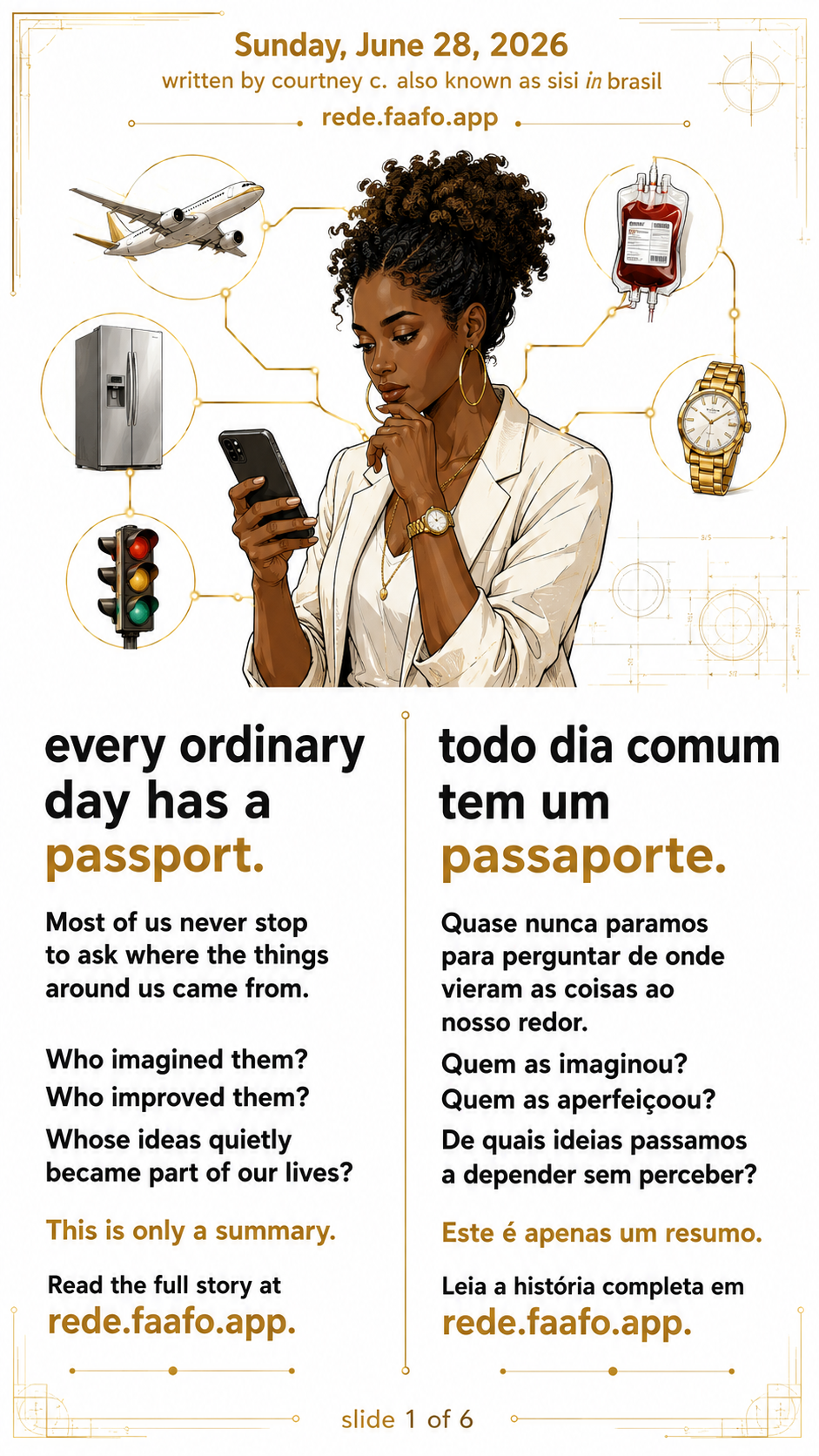
you reheated something. the microwave came from a mistake. percy spencer, an american engineer who never finished grammar school, was standing near radar equipment in 1945 when a chocolate bar melted in his pocket. he got curious instead of moving on. that curiosity is in your kitchen now.
you opened the fridge and the food was still good. then think about how that food got to you. frederick mckinley jones, an african american inventor from ohio, built the first practical refrigeration unit for trucks in the late 1930s. before him, you shipped food packed in ice and prayed it lasted. because of him, you can eat fresh fruit in a place and season where it does not grow. the same units later carried blood and medicine to soldiers in the war.
you left the house and the traffic actually moved in turns. the three-position traffic signal, the one with the pause between stop and go, was patented in 1923 by garrett morgan, an african american inventor in cleveland, the son of formerly enslaved parents. before that, signals only said stop or go with no warning, and people died in the gap. he also built an early breathing hood that became the ancestor of the gas mask, and he used it himself to pull men out of a collapsed tunnel under lake erie.
maybe you had music in your ears on the way. the idea of carrying your own private soundtrack, headphones on, walking through the world, was dreamed up by andreas pavel. he was born in germany, raised in são paulo from the age of six, and he built his “stereobelt” in 1972, years before sony sold the walkman. he spent decades fighting sony in court to be recognized. the thing you do every single day, the personal soundtrack, was imagined by a man who grew up in brasil.
now the big one. the one brasil and the united states will never agree on.
ask a brazilian child who invented the airplane and they will say alberto santos-dumont. october 1906, paris, the 14-bis, the first heavier-than-air flight publicly certified in europe. it took off on its own wheels, in the open, in front of officials.
ask an american child and they will say the wright brothers. december 1903, kitty hawk, three years earlier, but done quietly and in private.
both children are certain. both think the other country is simply wrong. and that is the whole point. who gets to be “the inventor” depends almost entirely on where you were born and which story you were raised inside. the disagreement is not a footnote. the disagreement is the lesson.
and one beautiful detail. santos-dumont could not check his pocket watch while his hands were busy flying, so his friend made him a watch he could wear on his wrist. that is one origin of the wristwatch on a lot of arms today. a brazilian problem, solved in france, worn worldwide.
and here is a brazilian they probably never taught you about, in either country.
andré rebouças. born in 1838 in cachoeira, bahia. the grandson of a man who had been enslaved. he became a military engineer and an inventor, and during the paraguayan war he built one of the first self-propelled torpedoes in the world, a design that came before the famous european version everyone credits. a black man from bahia, ahead of europe, and almost nobody says his name.
but the part that matters more than a weapon is what he did with the same mind in peacetime. he built railroads and the docks that moved a country’s goods. he worked on water-supply systems to keep people alive through drought. then he gave his money and his name to the fight to end slavery in brasil. an afro-brazilian from bahia helped engineer the modern country, and helped free it, and still got written out of the story. that erasure is the same instinct as telling a foreigner to be quiet. it decides in advance whose ideas are allowed to count.
so far this has been about convenience. now the part that is not optional.
if you or someone you love has ever needed blood, you owe a debt to charles drew, an african american surgeon who worked out how to store and bank blood plasma at scale, and who organized the first large blood banks just as the second world war began. he later resigned from the red cross because it segregated blood by race, which he knew had no scientific basis at all. his work is the reason a transfusion is even possible.
if you have ever clicked a seatbelt, that specific design, the three-point belt across your chest and lap, came from nils bohlin, an engineer at volvo in sweden, in 1959. volvo held the patent and then gave it away for free to every other carmaker, because they decided saving lives mattered more than money. it is credited with more than a million lives saved.
and if you live anywhere snakes do, you owe a brazilian your life without knowing it. vital brazil, working in são paulo at the start of the 1900s, watched rural workers die by the thousands from snakebite. he read what a french scientist had done with serum against cobra venom, an idea from the other side of the world, and he used it to build the first antivenoms for brazilian snakes, then the first serums that could cover several venoms at once. snakes, spiders, scorpions. the antivenom that exists today traces back to a brazilian who borrowed an idea from france and turned it into survival for the global south. that is the whole point again. nobody builds alone, and no country does it by itself.
and the one almost nobody talks about. oral rehydration solution. a precise mix of salt, sugar, and clean water that stops people, especially small children, from dying of dehydration from diarrhea. it was developed by bengali and american researchers in dhaka, and it proved itself during the 1971 war when doctors used it on cholera-stricken refugees and dropped the death rate from around thirty percent to almost nothing. the lancet called it potentially the most important medical advance of the twentieth century. it has saved an estimated fifty million lives. salt, sugar, water, and the knowledge of how to mix them, out of bangladesh, into the whole world.
so who taught us not to trust each other?
because someone did. somewhere along the way we learned to be suspicious of the foreigner, the other culture, the other ethnicity, the accent that is not ours. but look at your own day. you already trust them.
you trust a foreigner’s invention to heat your food, to hold the traffic so you cross safely, to keep your heart going in a hospital, to catch your body in a crash. you put your life in the hands of strangers from other countries every single hour and never once flinch. the distrust was taught to you. the trust was already there.
so the next time someone from somewhere else offers you a better way, and your first instinct is to tell them this is not their country, this is not their place, they should stay quiet. pause.
the phone you would say it on was born in chicago. the app was built by a refugee. your car is safer because of sweden. your fridge runs on the mind of a man whose parents were enslaved. your blood is bankable because of a black surgeon. your child can survive a fever because of a war in bangladesh. the sky has planes in it because two countries each insist their own son did it first.
so imagine how much richer our lives would be if we stopped there.
imagine if we were as open and curious and welcoming with the people as we already are with the things they make. right now we happily accept the invention and reject the inventor. we keep the gift and turn away the hand that offered it. what would it actually cost you to be a little more open, a little more curious, a little more willing to believe that the next person who looks or sounds nothing like you might be holding the very next thing that saves your life.
none of it can be sent back where it came from. it came from everywhere. that is not a threat to who you are. that is the proof that we were always building this together. and honestly, that is its own kind of magic.
sources:
- cell phone: martin cooper, motorola engineer, made the first public handheld cell phone call april 3, 1973. (britannica; npr; cnn)
- whatsapp: jan koum, ukrainian immigrant to the us (arrived at 16, family on food stamps), co-founded whatsapp with brian acton, 2009. (abc news; hustle fund)
- microwave: percy spencer, american raytheon engineer, discovered microwave cooking in 1945; first patent filed oct 8, 1945. (wikipedia; smithsonian/lemelson)
- refrigerated transport: frederick mckinley jones, african american inventor, built the first practical truck refrigeration unit (late 1930s), co-founded thermo king; units later carried blood/medicine in wwii. (national inventors hall of fame; blackpast)
- traffic signal + gas mask precursor: garrett morgan, african american inventor, first to patent the three-position traffic signal (1923); patented a “safety hood” (1912) preceding the gas mask; used it in the 1916 lake erie tunnel rescue. (britannica; fhwa)
- portable personal stereo: andreas pavel, german-born, raised in são paulo from age 6, conceived the “stereobelt” in 1972 (patented 1977), before sony’s 1979 walkman; later won a settlement from sony. (wikipedia)
- airplane: santos-dumont (brazilian) flew the 14-bis in paris, oct/nov 1906, first publicly certified heavier-than-air flight in europe; wright brothers (american) achieved sustained controlled flight in 1903 but privately. (britannica; wikipedia)
- wristwatch: cartier made an early wristwatch for santos-dumont so he could read the time while flying. (widely documented; firm up a stronger cite if you want it load-bearing)
- andré rebouças: afro-brazilian military engineer, inventor, abolitionist, born 1838 in cachoeira, bahia, grandson of a manumitted enslaved man; built one of the world’s earliest self-propelled torpedoes (1864–66), predating robert whitehead; directed railroads and rio docks. (wikipedia; blackpast; oxford african american studies center). flag: the drought water-supply line is from lighter sources; keep torpedo, railroads/docks, bahia origin, and abolitionism as load-bearing.
- blood banking: charles drew, african american surgeon, pioneered blood plasma storage and organized the first large blood banks (blood for britain, 1940; first red cross blood bank, 1941); resigned over racial segregation of blood. (britannica; smithsonian nmaahc). note: the story that he died because a hospital refused him a transfusion is debunked.
- seatbelt: nils bohlin, volvo (sweden), three-point seatbelt 1959; patent released free; 1m+ lives saved. (volvo group; nyt obit)
- vital brazil: brazilian physician, founding director of instituto butantan (são paulo, 1901); built on french scientist albert calmette’s anti-cobra serum work to develop the first monovalent and polyvalent antivenoms for south american snakes, plus spiders and scorpions. (wikipedia “antivenom”; pubmed/toxicon; plos ntd)
- oral rehydration solution: developed by bengali and american researchers in dhaka in the late 1960s; proven during the 1971 war; cut cholera fatality from ~30% to ~1%; the lancet called it potentially the most important medical advance of the 20th century; ~50 million lives saved. (our world in data; prx; pubmed)